
How to Spot Fake Climbing Gear: A Practical Guide
Last Updated: November 10, 2026
Quick Summary
Fake climbing gear often looks identical to the real thing, so check the certification marks, match the model and batch codes against the manufacturer's records, and inspect stitching, webbing and hardware for clean, consistent workmanship. Treat any check you cannot complete as a failure.
- A CE mark alone proves nothing, since counterfeiters copy marks too.
- Match the model name, model number and batch code against the manufacturer's published documentation.
- Check stitching, webbing and hardware for even lines, consistent width and clean machining.
- Be wary of unusually low prices and marketplace sellers you cannot verify.
- Stop using any piece that fails your checks, and keep photos and seller records to report it.
Table of Contents
- Why Counterfeit Climbing Gear Is Dangerous
- Start With the Certification Marks: CE Certification Climbing Gear Basics
- Petzl Serial Number Check: Reading and Verifying Model Data
- Inspecting Build Quality: Stitching, Webbing, Hardware and Wear
- Buying Climbing Gear on Amazon and Other Marketplaces Safely
- A Step-by-Step Verification Workflow for Each Gear Type
- What to Do If You Find Suspected Counterfeit Gear
- Choosing Certified Climbing Gear From a Store You Can Verify
- Frequently Asked Questions
Why Counterfeit Climbing Gear Is Dangerous
Counterfeit climbing gear is one of the less visible risks in the outdoor market, and the consequences of trusting it can be severe. A fake carabiner, sling or rope may look almost identical to the real thing, yet it has not been tested to the load ratings printed on its packaging, which is why shoppers should be wary of any fake climbing gear sold online.
Certified equipment is made to documented specifications and tested against recognised safety standards, while counterfeit pieces often skip that process. To see what goes into professional-grade climbing gear manufacturing, read our explanation of why genuine gear costs more. Nobody can tell from a photograph whether a webbing sling will hold a fall, that uncertainty is the real hazard.
The most dangerous fakes pass a quick glance. A sling with neat stitching and a convincing logo can still fail under load if the fibres or sewing were never engineered for the job, and a bad piece can look fine right up until it is needed.
Start With the Certification Marks: CE Certification Climbing Gear Basics
Certification marks are the first thing to check, and the first thing counterfeiters copy. A CE mark indicates that a product claims conformity with the relevant European requirements, but the mark on its own proves nothing about the piece in your hands. Treat it as a starting point for checking, not a guarantee.
Look for the mark alongside other details: a notified body number, the manufacturer's name, a model designation and a batch or production code. A lone logo with no supporting information should raise questions straight away.
Verifying a Mark, Not Just Recognizing One
Recognising a symbol tells you it looks right; verifying it means confirming the certification applies to this exact product. Counterfeit sellers reproduce marks convincingly, so visual familiarity is not enough.
Note the model name, model number and any batch code printed on the gear, then check these against the manufacturer's own product documentation or published certification information. If the manufacturer publishes no way to match a model to its certification, note that before you buy.
Where a certification body or notified body is named, look it up independently rather than trusting a link supplied by the seller. A mark that cannot be traced back to a real manufacturer record deserves suspicion.
Petzl Serial Number Check: Reading and Verifying Model Data
Many climbing equipment manufacturers print identifiers on their gear, and reading them carefully is one of the more practical checks available to a buyer. Using Petzl as an example, the markings on a product can often be matched against the manufacturer's product information to confirm the model and production period.
When you run a Petzl serial number check, compare what is stamped on the gear with the model details the manufacturer publishes, product name, model code and any date or batch information. A mismatch between the model name and the printed code is a red flag.
Not every brand offers the same level of public lookup, so adapt the process to the manufacturer. If you cannot confirm a serial or model number, treat the item with caution rather than assuming it is genuine.
Inspecting Build Quality: Stitching, Webbing, Hardware and Wear
Physical inspection won't prove authenticity on its own, but it reliably exposes poor manufacturing. Start with the stitching on any soft goods. Stitch lines should be even, tight and consistent, with no skipped stitches, loose ends or uneven spacing. Load-bearing points such as harness attachment points and sling ends deserve the closest look.
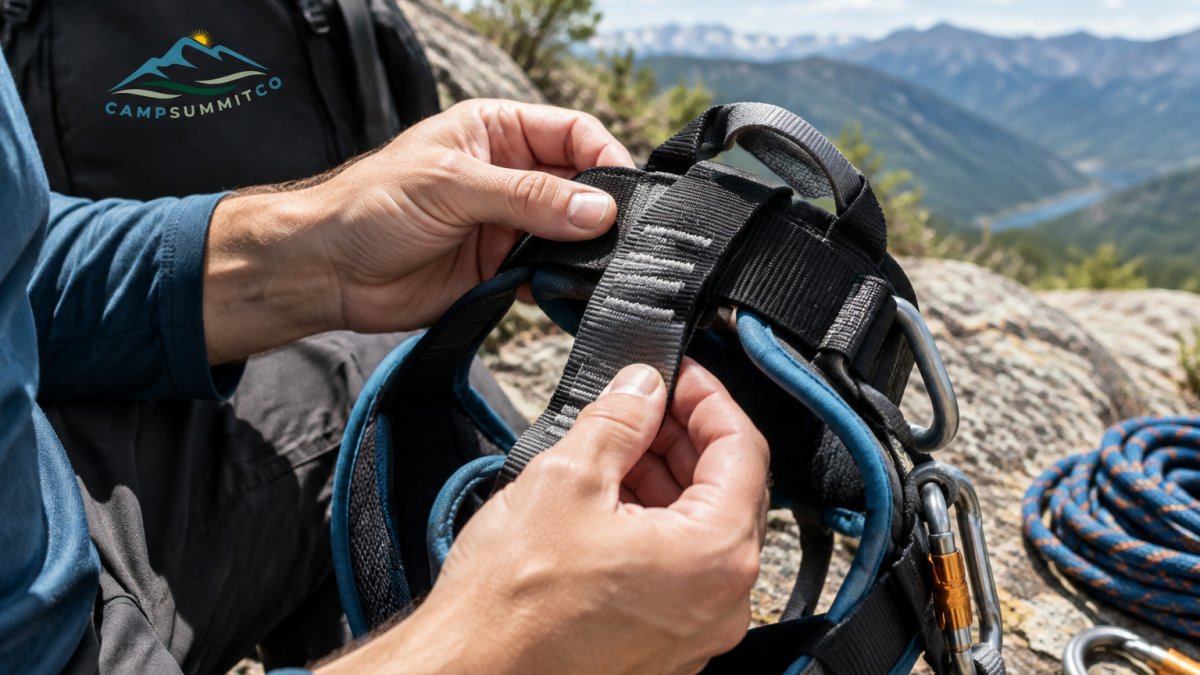
Next, examine the webbing. Run your hands along its length and check for fraying, fuzzy patches, thin spots or inconsistent width, comparing with a known genuine piece if you have one. Colour much brighter or duller than expected can also indicate lower-quality materials.
Finally, inspect the hardware. Carabiners and buckles should have clean machining, smooth gates that close and lock properly, and no sharp edges or casting flaws, with crisp rather than blurred markings. For used gear, look for cracks, bends, flattened sections and frayed wires. A clean inspection reduces risk but cannot confirm a piece will hold a fall.
Buying Climbing Gear on Amazon and Other Marketplaces Safely
Marketplaces are the highest-risk channel for counterfeit climbing gear because they mix genuine stock, authorised third-party sellers, grey-market imports and unbranded listings in the same search results. If you want durable, legitimate beginner climbing gear you can trust instead, start with a dedicated guide.
Seller identity and fulfillment. Open the seller's storefront and confirm who is actually selling the item. "Sold by [brand]" is not the same as sold and shipped by an unknown third party. Check how long the seller has been active, whether their other listings are climbing-specific, and whether the brand lists that seller as authorised.
Listing integrity. Compare the listing against the manufacturer's own product page, model name, model number, colourways, weight and certifications should match exactly. Listings that reuse manufacturer stock photos but show no traceable model number, or that use a slightly altered brand spelling or logo, are a recurring counterfeit signal.
SKU and barcode consistency. Where a listing shows a manufacturer SKU or barcode, compare it with the code on the manufacturer's site or on a known genuine item. Inconsistent SKUs across the same product, or a barcode that resolves to a different product, indicate a supply-chain problem. If the seller cannot supply the model number and batch code on request, treat that as a failed check.
Reviews and returns. Read the most recent reviews rather than the headline rating, looking for mentions of missing certification labels, mismatched packaging, or gear that failed inspection. Confirm the return policy before buying: a seller who will not accept returns on safety equipment gives you little recourse.
Fulfillment and packaging. On arrival, check that packaging, labels and documentation match what the manufacturer publishes. Counterfeit gear often arrives in generic packaging, without the manual or certification card, or with a label that peels easily or is printed at low resolution. Photograph the packaging and labels before opening anything you may need to return.
Use a marketplace as a last resort for safety-critical items. Where you can, buy from an established retailer or directly from the manufacturer, keep receipts, and run the verification workflow below as soon as the gear arrives.
A Step-by-Step Verification Workflow for Each Gear Type
A single checklist is not enough because harnesses, ropes, carabiners and protection each fail in different ways and carry different markings. Use the gear-specific sequences below, and treat any step you cannot complete as a failed check.
Harnesses. Start with the certification label sewn into the waist belt or leg loops. Confirm the standard marked on the label matches the harness type (for example, a climbing harness standard rather than a via ferrata or work-at-height standard), and check that the manufacturer name, model, size and batch code are present.
Ropes. Check the certification marking on the rope end or on the label supplied with the rope, and confirm the diameter, length, rope type and standard match the manufacturer's listing for that model. Our guide to choosing climbing ropes explains what each of these specifications means before you buy.
Carabiners and hardware. Confirm the certification marking, the manufacturer name, the model and the major-axis strength rating are stamped or laser-etched crisply into the metal, not printed on a sticker. Match the model and strength rating against the manufacturer's published specifications. Open and close the gate repeatedly: it should move smoothly, snap shut firmly and lock without catching.
Protection (cams, nuts, ice screws). Check the certification marking, manufacturer, model and strength rating, and match them against the manufacturer's documentation. For cams, inspect the lobes for even machining, confirm the sling and trigger action work smoothly, and check the axle and spring for play or corrosion.
Soft goods (slings, cord, chalk bags). Inspect stitching, webbing width and colour consistency, and confirm the certification label and batch code are present. Run your hands along the length for thin spots, fuzzy patches or inconsistent width. A sling with neat stitching but no traceable batch code still fails the check.
Decide and record. If any step fails or cannot be confirmed, do not climb on the piece. Keep it separate from working gear, label it clearly, and record the identifiers, photographs and seller details so you can act on the finding.
Each gear type fails in different ways, so check the markings and build points listed below for every piece you buy.
| Gear type | Check | Warning sign |
|---|---|---|
| Harnesses | Certification label, model, size and batch code | Label present but no batch code |
| Ropes | Marking, diameter, length and batch code | Loose, fuzzy or unevenly woven sheath |
| Carabiners | Crisp stamped rating matching the manufacturer's figure | Gritty or loose gate action out of the box |
| Protection | Marking, model and strength rating | Cracked swage or worn trigger action |
| Soft goods | Stitching, webbing width and batch code | Neat stitching but no traceable batch code |
What to Do If You Find Suspected Counterfeit Gear
If a piece fails your checks, stop using it immediately, even if it looked fine on the rack. Label it clearly and store it away from your working gear.
Keep the evidence: photographs of the markings, the listing or receipt, and any correspondence with the seller. Contact the retailer or marketplace first and ask for a refund or replacement, explaining what you found. Many platforms take counterfeit reports seriously and can remove listings.
If you believe the gear was sold as genuine when it is not, consider reporting it to the manufacturer and to the consumer protection authority in your country. Reporting helps protect other climbers from buying the same fake.
Choosing Certified Climbing Gear From a Store You Can Verify
The safest long-term approach is to buy from a retailer you can verify, one that can show you the documentation behind what it sells. At CampSummitCo, we offer a curated selection of outdoor gear designed to support your next adventure. Browse our roundup of the best alternatives to backcountry-style climbing gear to compare options.
Whichever store you use, look for clear product listings with model numbers, transparent return policies and a way to contact someone who can answer certification questions.
Careful buying is part of climbing safety. Verify the marks, read the identifiers, inspect the build and buy where you can trace the origin, and you will avoid most of the risks counterfeit gear creates.
Frequently Asked Questions
Why is counterfeit climbing gear dangerous?
Counterfeit climbing gear is often built from weaker webbing, thinner stitching and lower-grade metal than the certified original, so it may not hold the forces a fall generates. Because counterfeits copy logos and labels, they can look correct at a glance while failing under load. Gear that has not been tested to a recognised standard gives no assurance of its strength. If you suspect a piece is fake, retire it from use rather than testing it on a real climb.
How can I verify if my climbing gear is CE certified?
Look for the CE mark along with a notified body number and the EN standard the product claims to meet, then check the manufacturer's declaration of conformity or product documentation. Confirm the model number and batch details match the manufacturer's records. A printed CE mark alone is not proof, since lookalike marks are common. Buying from an authorised seller and keeping the original packaging and paperwork makes verification much easier.
Is it safe to buy climbing gear on Amazon or eBay?
It can be, but marketplaces carry higher counterfeit risk because third-party sellers can list products with little verification. Check whether the listing is sold and shipped by the brand or an authorised dealer, review the seller's history, and be wary of prices far below normal retail. Compare the product's markings, model number and packaging against the manufacturer's own product pages before you climb on it. When in doubt, buy from a retailer you can verify directly.
