
Is a 6 Person Tent With a Room Divider Worth It?
Last Updated: October 30, 2026
Quick Summary
A 6 person tent with a room divider buys you a second room, not a second tent. The divider is a fabric panel that splits one large interior into two sleeping or living zones, adding privacy without a second shelter. It adds no floor space, headroom, or weather protection, so buy one for the layout, not the capacity.
- Plan for four adults or a family of five in a 6-person tent with a divider.
- A divider hung from a dedicated ridge line and clipped at the walls stays taut instead of sagging.
- Full-height, floor-to-ceiling coverage gives real privacy, but only cabin-style tents with straight walls allow it.
- Dividers block sightlines, not sound, so pack earplugs if quiet matters.
- A cabin tent with a divider and screen room can fill most of a car trunk, so measure your trunk first.
Table of Contents
- What a 6 Person Tent With a Room Divider Actually Buys You
- 6 Person Tent With Separate Rooms: Divider Configurations in Practice
- 6 Person Cabin Tent: Straight Walls, Center Height and Standing Room
- Waterproof 6 Person Tent: Rainfly Design, Seams and Ventilation Trade-Offs
- 6 Person Tent With Screen Room: Privacy Versus Bug-Free Living Space
- Setup, Packed Size and What to Look For Before You Buy
- Matching the Tent to Your Trip and Shopping at CampSummitCo
- Frequently Asked Questions
What a 6 Person Tent With a Room Divider Actually Buys You
A 6 person tent with a room divider buys you a second room, not a second tent. The divider is a fabric panel that hangs from the ceiling to split one large interior into two sleeping or living zones. Families and small groups gravitate toward this layout because it solves the one problem dome tents can't: privacy without a second shelter.
A divider adds no floor space, headroom, or weather protection, it reorganizes what you already have. Buy one for the layout, not the capacity.
Here is the math most listings skip: a "6-person" rating assumes six sleeping bags side by side with no gear. A 6-person tent with a divider typically splits into two zones of roughly three people each, comfortable for four to five actual campers plus gear.
How Many People and How Much Gear Really Fit
Plan for four adults or a family of five in a 6-person tent with a divider. Six adults fit only if everyone sleeps on thin pads with bags stored outside.
Gear storage is the real constraint. A divider eats a strip of floor space down the middle, so each half holds less than half the total. Store duffels in the corners and keep the center aisle clear.
Families comparing capacity often want to see how a smaller layout feels before committing. Our guide to the best 4 person tent for family camping shows what a tighter footprint looks like, which helps you judge whether downsizing or upsizing suits your group.
6 Person Tent With Separate Rooms: Divider Configurations in Practice
Most dividers are a single zippered curtain: two rooms when closed, one big room when rolled back. That flexibility is the point, but how the panel is built and hung determines whether the second room is genuinely private or just a visual suggestion.
How dividers attach (and why it matters)
Dividers hang from one of four mounting systems, and each behaves differently over a season of use:
- Ceiling clips or toggles: The panel clips to loops sewn into the roof. Fast to remove and re-hang, and easy to replace if a clip breaks. Look for metal or reinforced plastic clips rather than thin ties.
- Sleeved ridge line: The panel slides onto a dedicated pole or cord running across the ceiling. This keeps the top edge taut so the curtain doesn't sag into the sleeping area, the most common divider failure.
- Zippered perimeter: The divider zips to the walls and floor as well as the ceiling, creating a near-sealed room. Best privacy, slowest to open and close, and the zippers are the wear point.
A divider hung from a dedicated ridge line and clipped at the walls stays taut; one held only by thin ties sags into the middle of the tent and snags on sleeping bags. A sagging divider is worse than none.
Floor-to-ceiling coverage: the privacy test
Ask two questions before buying: does the divider reach the floor, and does it reach the ceiling?
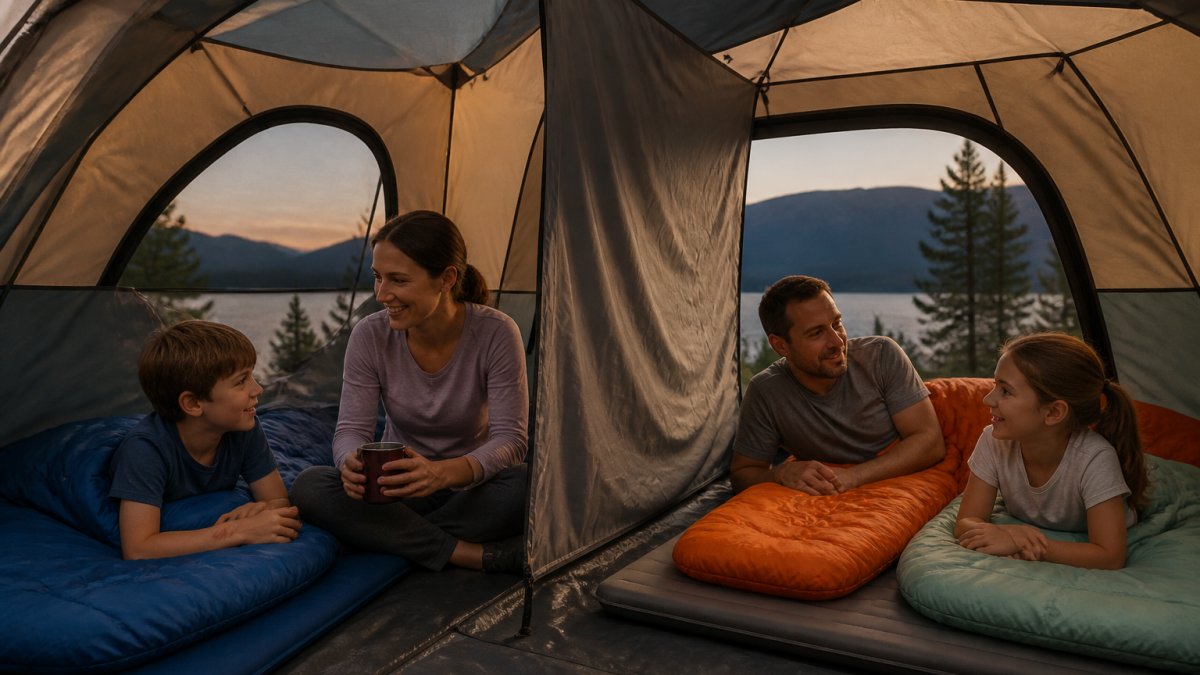
- Full height, floor to ceiling: Real privacy. You can change clothes, read with a light on, and keep one side dark for a sleeping child. Only practical in a cabin-style tent with straight walls, because a dome's curved roof shortens the panel.
- Eye-level only (stops short of the floor): Blocks sightlines when standing or sitting but leaves a gap at the bottom. Useful for parents who want airflow and a sightline to young children, but not for changing clothes in front of older kids or other adults.
- Ceiling gap: A panel that stops below the roof lets light and sound through the top. Fine between adults who trust each other; not fine if one side stays up late.
The three layouts in practice
- Center split: Two equal halves, best for two couples or a family with older kids who want their own zone. Each half typically fits two adults on pads with duffels in the corners; a third person per side means thin pads and bags stored outside.
- Offset split: One large room and one small room. The small side works as a gear, changing, or dog zone while the large side sleeps the family. Good when one adult rises early and needs space without waking everyone.
- Partial divider: A panel that stops short of the floor, giving privacy at eye level while keeping airflow and sightlines for parents watching young children. Right for families with toddlers; wrong for two couples sharing.
Removable or fixed?
Most dividers are removable, they unclip, unzip, or slide off the ridge line so the tent converts to one open room. Removability lets you open the space for daytime living, wash or replace a damaged panel, and leave it home when privacy isn't needed.
When comparing tents, check whether replacement dividers and clips are sold separately, a divider is a wear item.
6 Person Cabin Tent: Straight Walls, Center Height and Standing Room
A 6 person cabin tent is the layout that makes a divider worth having. Straight walls rise vertically before angling to the roof, so usable floor space extends nearly to the edges. Dome tents curve inward, stealing exactly the space where you want to stand and change clothes.
Center height is a spec worth checking. Look for a center height that lets your tallest adult stand without stooping.
Straight walls also make the divider more useful.
The trade-off is weight and packed size. Cabin tents use more fabric and more pole, so they're heavier and bulkier in the carry bag. If you're driving to a campsite, that's fine.
Waterproof 6 Person Tent: Rainfly Design, Seams and Ventilation Trade-Offs
A waterproof 6 person tent depends on three things working together: the rainfly, the seams, and ventilation. Get one wrong and the others can't save you.
Start with the rainfly. A full-coverage fly that reaches low on the walls sheds rain far better than a partial cap.
Coleman 4-Person Flatwoods II Lightweight Dome Camping Tent - Red →
Seams are the quiet failure point. Taped or welded seams hold up; stitched seams need seam sealing over time.
Ventilation is where waterproofing and breathability fight each other.
6 Person Tent With Screen Room: Privacy Versus Bug-Free Living Space
A 6 person tent with screen room trades interior privacy for outdoor living space. The screen room is a mesh-walled porch, usually under its own fly, that gives you a bug-free place to sit, eat, or store gear without bringing dirt into the sleeping area.
The trade-off is straightforward: a screen room adds footprint and packed weight, and it usually replaces the second interior room rather than adding to it.
Which is better depends on how you camp. If evenings are spent around a fire and the tent is only for sleeping, interior privacy wins.
One practical note: screen rooms need their own ground sheet or they collect moisture and dirt fast.
Setup, Packed Size and What to Look For Before You Buy
Setup difficulty scales with pole count, and cabin tents with dividers use more poles than simple domes. The useful comparison isn't "easy vs. hard", it's how many poles, how many people, and how much trunk space you're trading for the second room.
Setup: what actually drives time
Three factors decide whether a tent pitches in ten minutes or forty:
- Pole count and configuration: A simple two-pole dome pitches fast. A cabin tent with a divider typically uses a frame of intersecting poles plus a ridge line for the divider, roughly doubling the pole count. More poles means more sleeves, more clips, and more chances to thread the wrong pole.
- Sleeves vs. clips: Clip-on poles go up faster than sleeves, especially in wind, but sleeves hold the pole more securely and usually stand up better in gusts. Many cabin tents mix both, clips on the body, sleeves on the brow pole.
- Instant-setup frames: Pre-assembled hubs cut pitching time dramatically, but add bulk and weight and often limit interior height. They suit car campers who pitch and strike every day; they're a poor fit for anyone counting ounces.
Setup time depends heavily on pole count and wind conditions, so pitch the tent once at home to learn your own timing. Treat these as planning ranges, pole count and wind matter more than the marketing claim.
Packed size and weight: the trunk test
Packed size decides whether the tent fits your trip. A cabin tent with a divider and a screen room can fill most of a car trunk. Measure your trunk before you buy.
What to compare on the spec sheet:
- Packed dimensions (length × width × height): The long dimension is what fights your trunk and back seat. A tent bag over about 30 inches long rarely fits crosswise in a compact car.
- Packed weight: Cabin tents with dividers and screen rooms are heavier than domes of the same capacity because they use more fabric and more pole. Plan for two people to carry a large cabin tent bag any distance.
- Carry bag design: A duffel-style bag with compression straps and a wide opening is far easier to repack than a narrow stuff sack. Backpack-style straps help on the walk from car to site.
The decision framework
| Your situation | What to prioritize | What to accept |
|---|---|---|
| Family of four, car camping | Cabin layout, full-height divider | Heavier packed weight |
| Two couples sharing | Center-split divider, two doors | Less living space |
| Bug-heavy or rainy region | Screen room, full-coverage rainfly | Bigger footprint |
| Mixed ages, watching kids | Partial divider, mesh sightlines | Less visual privacy |
| Windy, exposed sites | Traditional poles, low fly | Slower setup |
| Pitching daily on a road trip | Instant-setup frame | Bulkier packed size |
If packed size and setup effort are your main worry, our breakdown of lightweight shelter solutions for backpacking covers how smaller shelters trade space for portability, which helps you decide whether a big cabin tent is the right call at all.
Before you commit
Check the return policy, the warranty, and whether the brand stocks replacement poles, flies, and divider clips, parts availability matters more than a spec sheet. If you can, set the packed bag next to your vehicle's trunk opening; the long dimension decides whether the tent comes home with you.
Matching the Tent to Your Trip and Shopping at CampSummitCo
The right 6 person tent with a room divider matches your group and your campsite, not the longest feature list. Match the layout to how you actually sleep, then the weight and packed size to how you actually travel.
CampSummitCo stocks shelter options built for real trips, including the tents listed in our catalog. Our gear is chosen for people who move with purpose.
Frequently Asked Questions
Do 6-person tents with room dividers provide separate bedrooms?
A divider gives you two distinct sleeping zones under one shell, but it is a fabric partition, not a wall. It blocks sightlines and creates a sense of privacy for changing clothes or settling kids down, yet sound and airflow still pass through. Most dividers hang from the ceiling and can be toggled open or removed entirely, so the same tent works as one big room on a group trip and two rooms on a family trip.
How much floor space does a 6-person tent need for a family?
Treat the stated capacity as a maximum, not a target. Six people on six sleeping pads fill nearly every square centimetre of floor, leaving nowhere for bags, boots or a cooler. For a family of four plus gear, look for interior dimensions that leave a clear strip of floor space between sleeping areas. Check center height too: standing room changes how usable that floor space feels on a rainy day.
Is a screen room the same as a room divider in a tent?
No. A room divider is an internal fabric panel that splits the sleeping area into two zones. A screen room is a separate mesh-walled section, usually at the front, that keeps bugs out while letting air through. Some multi-room tents combine both: a divider for the sleeping quarters and a screened porch for sitting. Decide which one you will actually use before paying for both.
What should I look for in a waterproof 6 person tent?
Check the rainfly coverage first, then the floor. A full-coverage rainfly that reaches low on the walls sheds rain far better than a small cap fly. Look for a tub-style floor with welded corners, taped or protected seams, and covered zippers. Ventilation matters just as much: mesh windows and roof vents reduce condensation, which is the most common reason campers wake up damp in an otherwise waterproof tent.
Can you remove the room divider in a family tent?
Check the product listing for the specific attachment method, since it varies by model. That flexibility is worth checking before you buy, because it lets one tent cover both a couple wanting a single open space and a family needing two rooms. Confirm the attachment method in the product listing rather than assuming.
