
How to Choose a Dry Bag Size for Kayaking
Table of Contents
- Understanding Dry Bag Capacity and Trip Duration
- What Size Dry Bag for Kayaking: Matching Capacity to Needs
- 20L Dry Bag Kayaking: Is This Size Right for You?
- How to Pack a Dry Bag for Kayaking Efficiently
- Best Dry Bag for Kayaking: Fitting Bags Into Kayak Hatches
- Single Large Bag Versus Multiple Small Bags
- Kayak Type and Storage Space Considerations
- Common Mistakes When Choosing Dry Bag Size
- Frequently Asked Questions
Last Updated: October 10, 2026
Understanding Dry Bag Capacity and Trip Duration
Understanding how to choose a dry bag size for kayaking starts with trip length, the strongest predictor of dry bag capacity you need. A day paddle requires far less gear than a multi-day expedition. Understanding this relationship helps you avoid buying bags that are too small or so large they waste space and add weight.

Day trips and half-day paddles
For day trips under six hours, a 5-liter to 10-liter bag handles essentials: phone, wallet, keys, snacks, and a light layer. Avoid oversizing, a bag that's too large tempts overpacking, which affects kayak stability and paddler fatigue.
Overnight and multi-day expeditions
Overnight trips require 20-35 liters. Many paddlers use two or three bags: one large bag for sleeping gear and bulky items, smaller bags for food and personal items. Multiple bags improve weight distribution and kayak balance over long distances.
What Size Dry Bag for Kayaking: Matching Capacity to Needs
The best approach to choosing how to choose a dry bag size for kayaking is matching capacity directly to what you're actually bringing. Don't guess. Make a packing list first, then measure or estimate the volume you need.
Small bags (2L to 10L)
Small dry bags hold essentials: a 5-liter bag fits phone, keys, wallet, and snack; a 10-liter bag adds room for a light jacket or extra food. Ideal for paddlers who travel light without overnight gear.
Best for:
- Day trips under 6 hours
- Solo paddlers with minimal gear
- Kayaks with limited hatch space
Medium bags (20L to 35L)
A 20-liter bag holds a sleeping bag, change of clothes, toiletries, and food for one night. A 35-liter bag adds room for extra layers and comfort items. Many paddlers combine one medium bag with a small bag for quick-access items.
Large bags (50L to 90L)
Large bags (50-90L) are for serious expeditions: a 50-liter bag holds two to three nights of gear; a 90-liter bag handles week-long trips. Only buy if you regularly paddle multi-day trips.
20L Dry Bag Kayaking: Is This Size Right for You?
A 20L bag works best for one to two night trips if you travel light. Test it on a practice overnight trip before committing. If you prefer creature comforts or share gear with a partner, consider something larger.
How to Pack a Dry Bag for Kayaking Efficiently
Stated capacity differs from usable capacity, especially with roll-top bags where the closure mechanism and tapered design reduce available packing volume.
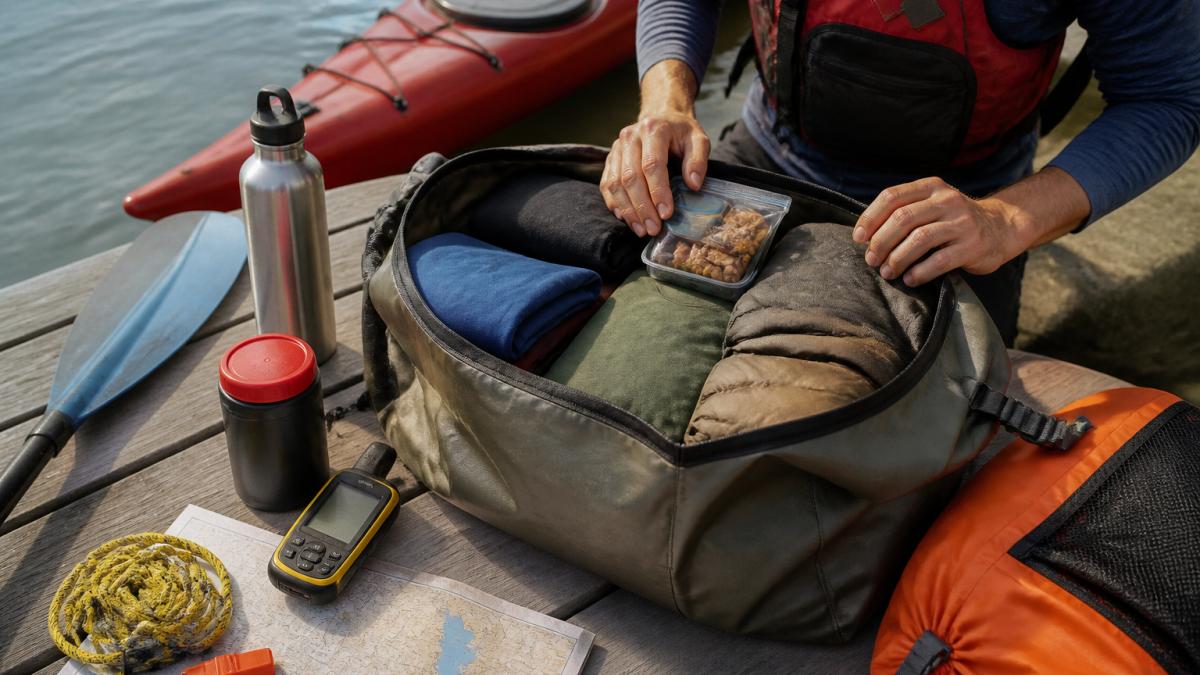
Understanding usable capacity in roll-top bags
A 20-liter roll-top bag typically gives 17-19 liters of usable space because you need 2-3 inches at the top to roll down securely. Tapered designs and irregular gear shapes further reduce efficiency. Add 1-2 liters to your estimated need; if you need 20 liters, choose a 22-23 liter bag.
Worked packing example: overnight kayak trip for one paddler
Here's a realistic packing list and how it breaks down by volume:
Overnight trip packing breakdown:
- Sleeping & shelter: 6-7 liters (sleeping bag, pad)
- Clothing & personal care: 4-5 liters (change of clothes, fleece, toiletries)
- Food & water: 3-4 liters (meals, snacks, water bottle)
- Safety & emergency: 1-2 liters (first-aid, headlamp, repair kit)
- Electronics & valuables: 0.5 liter (phone, keys, ID)
Total: 15-18 liters
A 20-liter bag is ideal for this trip, providing 17-19 liters of usable space with a safety margin.
Organizing gear by category and weight
Group gear by category and pack heavy items (sleeping bag, water, food) at the bottom, lighter items on top. Use smaller pouches inside your main bag to organize categories and keep everything findable.
Maximizing usable capacity with roll-top bags
Fill roll-top bags completely and roll the top down at least three times for an airtight seal. For multi-day trips with multiple bags, distribute weight evenly for better kayak balance.
| Packing Strategy | Best For | Benefit |
|---|---|---|
| One large bag | Multi-day trips, solo paddlers | Simpler to manage, fewer bags to track |
| Multiple small bags | Day trips, weight distribution | Better balance, easier access to items |
| Mixed approach (one large + one small) | Overnight trips, organized gear | Combines benefits of both methods |
Best Dry Bag for Kayaking: Fitting Bags Into Kayak Hatches
Your kayak's hatch size determines what bags will actually fit. A theoretically perfect bag is useless if it doesn't fit through your hatch opening, one of the most common purchasing mistakes.
How to measure your kayak hatch
Measure your hatch opening (widest point and depth) and usable storage depth (from opening to lowest point where gear sits). Note any internal ribs or obstacles that might block a bag.
Common hatch dimensions by kayak type:
| Kayak Type | Typical Hatch Opening | Usable Depth | Storage Capacity |
|---|---|---|---|
| Recreational (single) | 6-7 inches diameter | 12-16 inches | 15-30 liters |
| Recreational (tandem) | 6-8 inches diameter | 14-18 inches | 20-40 liters |
| Touring | 8-10 inches diameter | 20-28 inches | 50-80 liters |
| Sea kayak | 8-12 inches diameter | 24-32 inches | 60-100 liters |
| Sit-on-top | Open deck (no hatch) | N/A | Bungee/deck bag only |
These are typical ranges; your kayak may differ. Always measure your specific model.
Hatch dimensions and bag shape compatibility
Bag shape matters as much as size. A bag that's theoretically the right capacity might not fit your hatch because of its shape.
Cylindrical bags fit easily into round hatches and pack efficiently. Tapered bags (wider at base, narrower at top) fit more gear but are harder to insert through tight openings, the widest part must pass through. Rectangular bags work in rectangular hatches but not round openings.
Testing bag fit before purchase
Test the bag in your hatch if possible. Otherwise: check the retailer's return policy, compare bag dimensions to your hatch measurements, note the widest point of tapered bags (usually 1-2 inches below the top), and account for material thickness.
The Murphy - Waterproof Floating Backpack Dry Bag With Shell Bag →
Choosing cylindrical versus tapered designs
Cylindrical bags are easier to fit into round hatches and work well for recreational and touring kayaks with standard circular openings. They pack efficiently and don't waste space. However, they're less space-efficient than tapered designs because the top and bottom have the same diameter.
Tapered bags maximize usable capacity by using more of the hull's interior space (which is often wider at the base). They're ideal for kayaks with deep, wide hatches where you have room to maneuver the bag during insertion. However, they're harder to fit through tight openings and require more care when packing and unpacking.
For most kayaks, a cylindrical or slightly tapered bag works best. If your hatch opening is less than 7 inches in diameter, stick with cylindrical. If your hatch is 8+ inches and deep, a tapered bag gives you more usable volume.
Single Large Bag Versus Multiple Small Bags
This is a common decision point for kayakers. Should you carry one 35-liter bag or two 17-liter bags?
One large bag is simpler to manage. You pack once, load once, and you're done. It's faster and means fewer bags to organize.
Multiple small bags offer better weight distribution and easier access. If you need a snack mid-paddle, you don't have to unpack your entire bag. You can also remove one bag if you need to access a hatch for emergency equipment.
For most paddlers, the answer is: start with one medium bag and add a second small bag if you find yourself needing quick access to specific items.
Kayak Type and Storage Space Considerations
Different kayak designs have different storage capabilities. Understanding your kayak type helps you choose bags that actually fit and work well.
Recreational kayaks and day-trip storage
Recreational kayaks are designed for casual paddling and typically have one or two small hatches. Storage space is limited, usually 20 to 40 liters total. This means you're restricted to small to medium bags.
For recreational kayaks, a single 10-liter to 20-liter bag is usually the right choice. Trying to force larger bags will either fail or compromise your kayak's performance.
Touring kayaks and expedition capacity
Touring kayaks are built for longer trips and feature multiple large hatches with 50+ liters of storage. These boats can handle large bags and multiple bags without issue.
If you own a touring kayak, you have flexibility. You can use one large 50-liter bag or combine several smaller bags to distribute weight.
Sit-on-top kayaks and open deck packing
Sit-on-top kayaks have open decks with limited enclosed storage. Many paddlers use bungee cords or deck bags to secure gear on top. This means bag shape and size matter differently than with traditional kayaks.
For sit-on-tops, consider bags with attachment points or handles that work well with bungee systems. Smaller, lighter bags are often better because they're easier to secure and won't affect stability as much.
Common Mistakes When Choosing Dry Bag Size
Most paddlers make predictable mistakes when selecting bags. Recognizing these helps you avoid wasting money.
Ignoring hatch dimensions. Buying a bag that doesn't fit your kayak is the most frustrating mistake. Always measure your hatch before purchasing.
Buying one bag for all trip types. A 50-liter expedition bag is terrible for day trips. A 5-liter bag is useless for overnight paddling.
Overpacking because the bag is large. A larger bag tempts you to bring more than you need. Stick to your packing list and resist the urge to fill empty space.
Choosing the right dry bag size for kayaking comes down to matching capacity to your actual trip length and your kayak's storage space.
If you're ready to invest in quality gear, The Murphy Waterproof Floating Backpack Dry Bag from campsummitco offers 30-liter capacity with a magnetic auto-sealing closure rated waterproof to 100 feet.
Frequently Asked Questions
What size dry bag do I need for a day of kayaking?
For a day trip, a 5L to 10L dry bag typically works well for essentials like your phone, wallet, keys, and a light snack. If you're paddling longer hours or bringing extra clothing and food, step up to a 20L dry bag. The right size depends on your kayak's hatch dimensions and how much gear you actually carry. A 20L bag fits most recreational kayak hatches and gives you breathing room without excess bulk.
How do I know if my dry bag will fit in my kayak hatch?
Measure your kayak's hatch opening width and depth, then compare those dimensions to your dry bag's width and height when full. Cylindrical bags work best in circular hatches, while tapered bags fit better in oval or narrow openings. Many kayakers choose multiple smaller bags rather than one large bag to make fitting easier. Check your kayak's manual for hatch dimensions if you're unsure.
Is a 20L dry bag too big for kayaking?
A 20L dry bag is a versatile middle ground for most paddlers. It's too large for minimal day trips but ideal for half-day outings, overnight gear, or day trips where you want extra space for clothing and food. Whether it's right for you depends on your trip length, kayak storage capacity, and what you're carrying. Many recreational kayakers find 20L bags strike the best balance between capacity and hatch compatibility.
Should I use one large dry bag or multiple small bags for kayaking?
Multiple small bags offer better weight distribution, easier access to gear while paddling, and more flexibility fitting into hatches of different shapes. One large bag is simpler to pack and carry, but it can be harder to fit into narrow hatches and limits your ability to grab specific items without unpacking everything. Most experienced kayakers use a combination: a larger main bag for bulk items and smaller bags for essentials they need quick access to.